Candidate Code Search
Once a candidate works, should the agent refine it or try another direction? The answer depends not only on which candidate has the highest score, but also on whether the agent can propose a useful change to it. Selecting a parent and generating a modification are separate parts of search.
For the tabular classifier introduced in Overview, returning to a preprocessing variant selects a parent. Replacing its imputation procedure generates a modification. Keeping several variants is useful when they provide genuinely different next experiments, not simply because the history contains more nodes.
Choosing a Starting Point
Greedy selection prioritizes the best valid candidate measured so far. It need not erase earlier candidates or forbid new drafts. AIDE starts from several scripts and repairs failed branches, while prioritizing the best-scoring valid script for improvement (Jiang et al. 2025).
Monte Carlo tree search (MCTS) additionally uses visit counts and estimated branch value to balance revisiting promising candidates against exploring less-tested branches. Evolutionary search maintains a population and creates candidates through modification and recombination. These procedures allocate experiments. The operators that draft, repair, improve, or combine code determine what those experiments actually test.
AIRA separates these two design choices. Among the R1 bars in Figure 1, holding AIDE’s operators fixed while replacing greedy selection with MCTS or evolutionary search gave no clear benefit (Toledo et al. 2025).
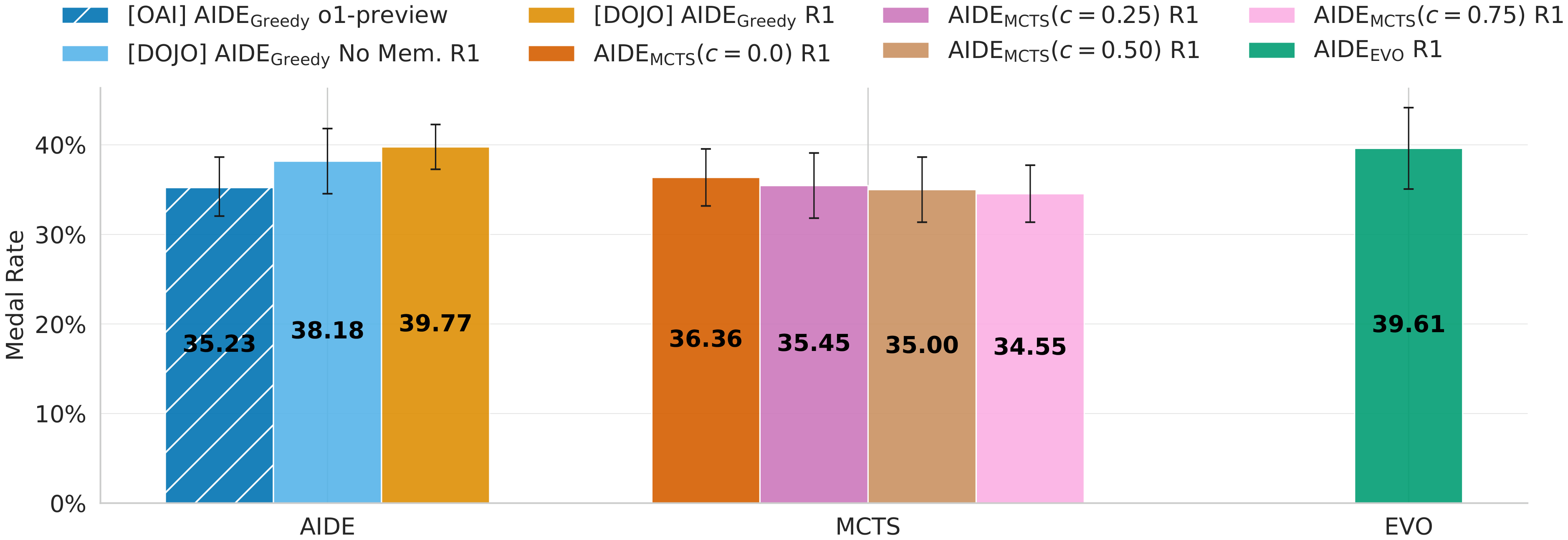
Changing the operators while retaining greedy selection did help. On the 22 MLE-bench Lite tasks with DeepSeek R1, a 24-hour budget, and one H200, medal rate increased from 39.8% to 45.5%. MCTS with the improved operators reached about 47%. The larger lesson is the interaction: a search policy can exploit only the opportunities its operators generate.
The improved operators tailor their inputs. Drafting and refinement see sibling attempts to avoid duplication. Debugging sees the repair ancestry to avoid undoing earlier fixes. Prompts also adjust complexity and encourage longer reasoning. These changes form a package, with roughly twice the output tokens, rather than an isolated test of memory scope (Toledo et al. 2025).
Choosing a Part to Change
A working pipeline contains several opportunities for improvement. Instead of repeatedly requesting a better whole script, an agent can first choose a component and then compare alternatives within it.
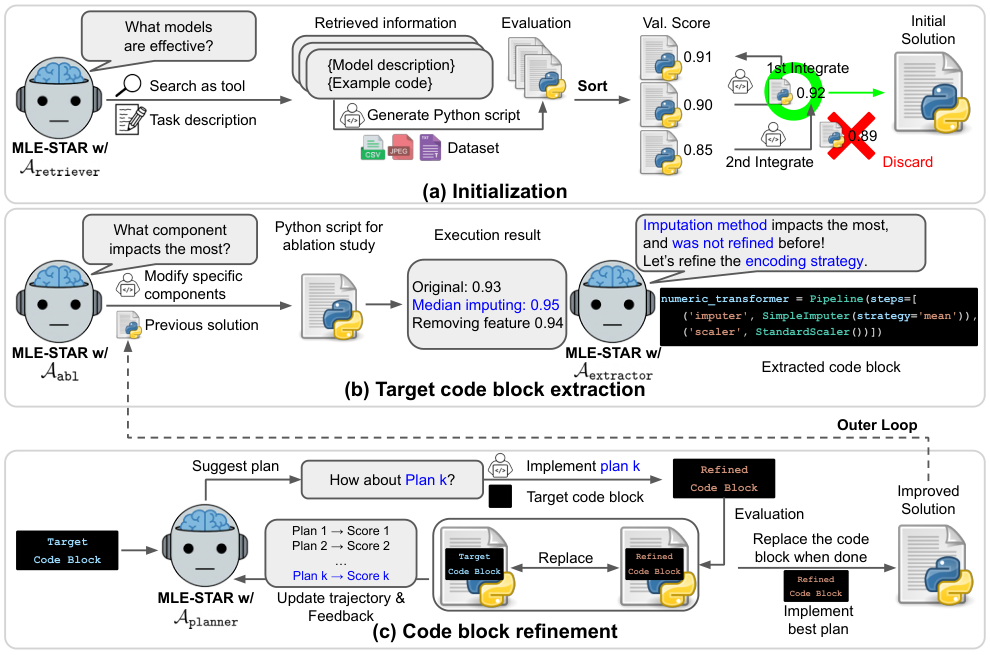
MLE-STAR implements this with the nested loops in Figure 2. The outer loop runs component ablations and selects a code block. The inner loop proposes and evaluates several changes to that block. Each proposal replaces the same starting block, making the alternatives comparable. Only a best proposal that improves the current solution carries into the next outer iteration (Nam et al. 2025).
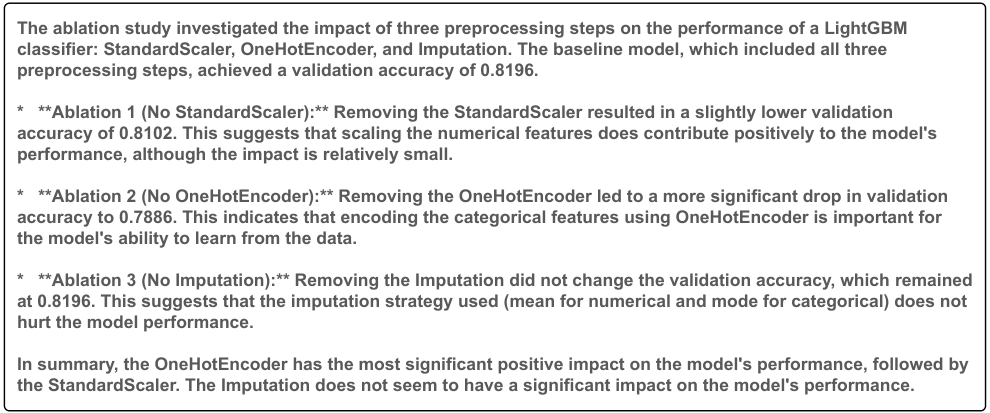
The classifier example in Figure 3 makes this choice concrete: removing one-hot encoding lowers validation accuracy, whereas removing imputation leaves it unchanged. That makes encoding worth investigating. A large loss after removing it establishes dependence on the current implementation, however, not the size of the improvement still available.
The final operation may combine predictions rather than select one pipeline. MLE-STAR also tests ensemble plans for independently generated solutions. The feedback loop in Figure 4 uses earlier ensemble attempts to propose and evaluate the next combination, rather than simply picking one parent.
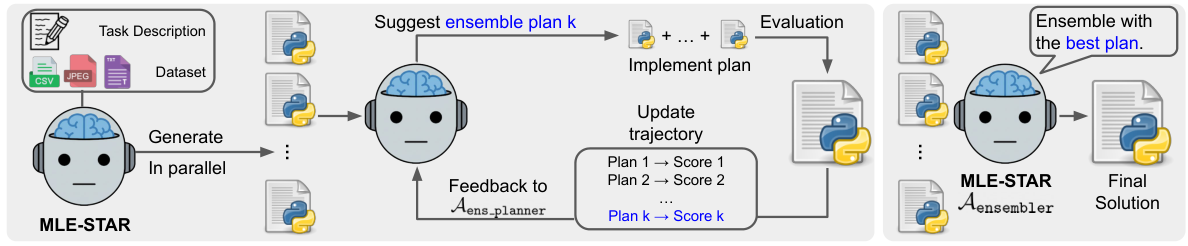
In three-seed experiments on MLE-bench Lite with Gemini-2.0-Flash, medal rates were 37.9% without this final stage, 42.4% for best-of-N selection (choosing the best of several solutions), and 43.9% for both prediction averaging and the proposed ensemble search. The proposed search obtained more gold medals than averaging, but did not improve every metric. Combining predictions from different solutions can therefore be useful beyond selecting the strongest individual candidate (Nam et al. 2025).
Turning Execution Feedback into Proposals
A score says which candidate performed better. Logs and code differences can suggest what to try next. This reasoning can operate inside a tree or within a simpler sequence of refinements.
ML-Master combines MCTS with selected information from parents and siblings. It limits this memory to the immediate parent and parallel siblings at the same depth. The arrows into the reasoning and code-generation stages in Figure 5 carry their plans, code, scores, and execution observations into the next proposal. Distilled reasoning insights and execution feedback enter the context the model uses to reason about its next change (Liu et al. 2025).
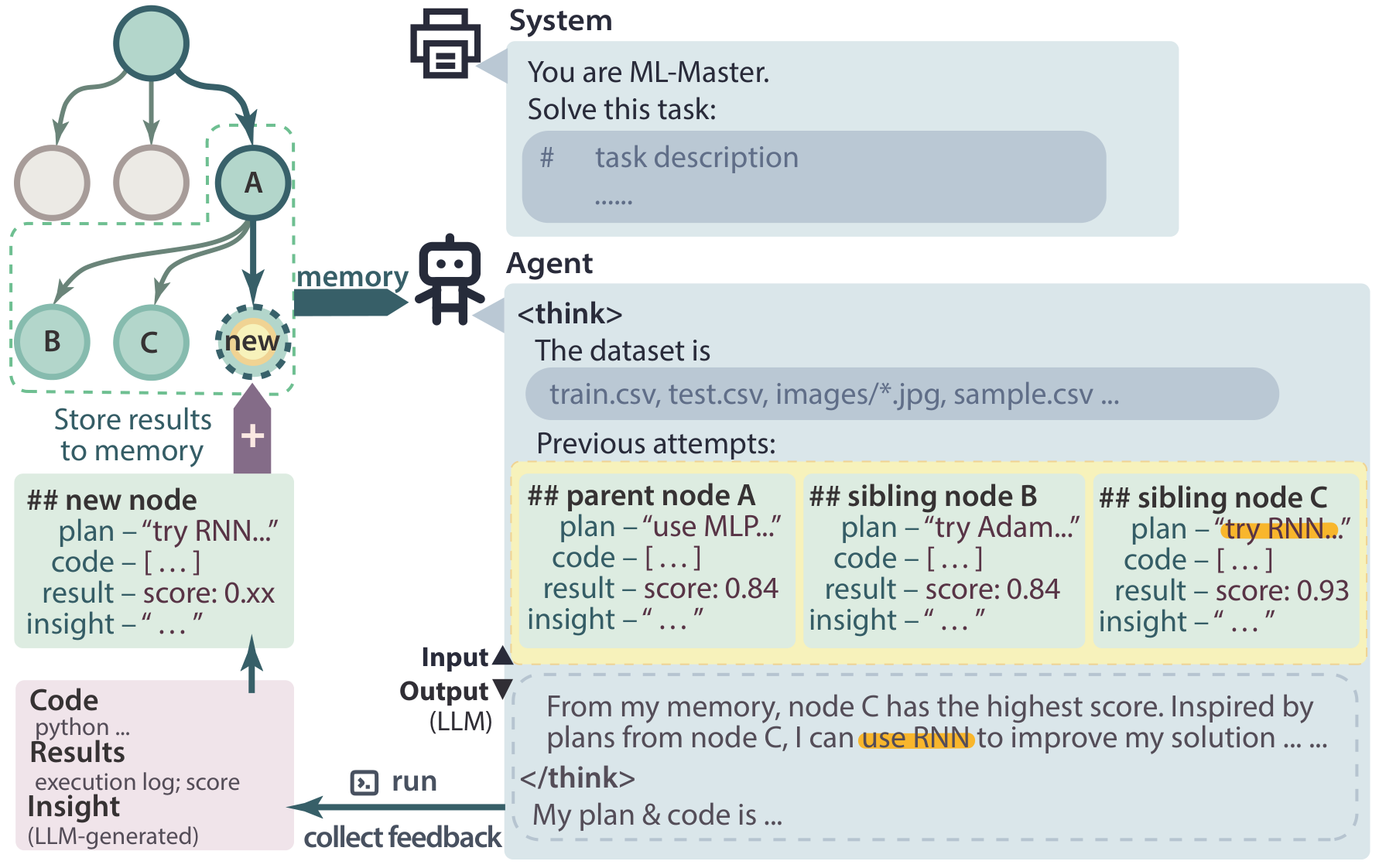
A slower sibling may reveal a useful feature but an unaffordable implementation. A failed sibling may show that a promising library is incompatible with the environment. Neither insight is captured by scalar ranking alone. ML-Master illustrates this design, though its report defers component ablations and does not establish memory’s isolated contribution.
Gome makes proposal generation more explicit. The stages in Figure 6 turn code differences, logs, and measured results into extracted issues, prioritized hypotheses, and one chosen change. Parallel trajectories share accepted successes. Before a hypothesis and its feedback enter shared memory, a validation gate checks output format, evaluation alignment, and the intended effect. A higher score alone is not sufficient (Zhang et al. 2026).
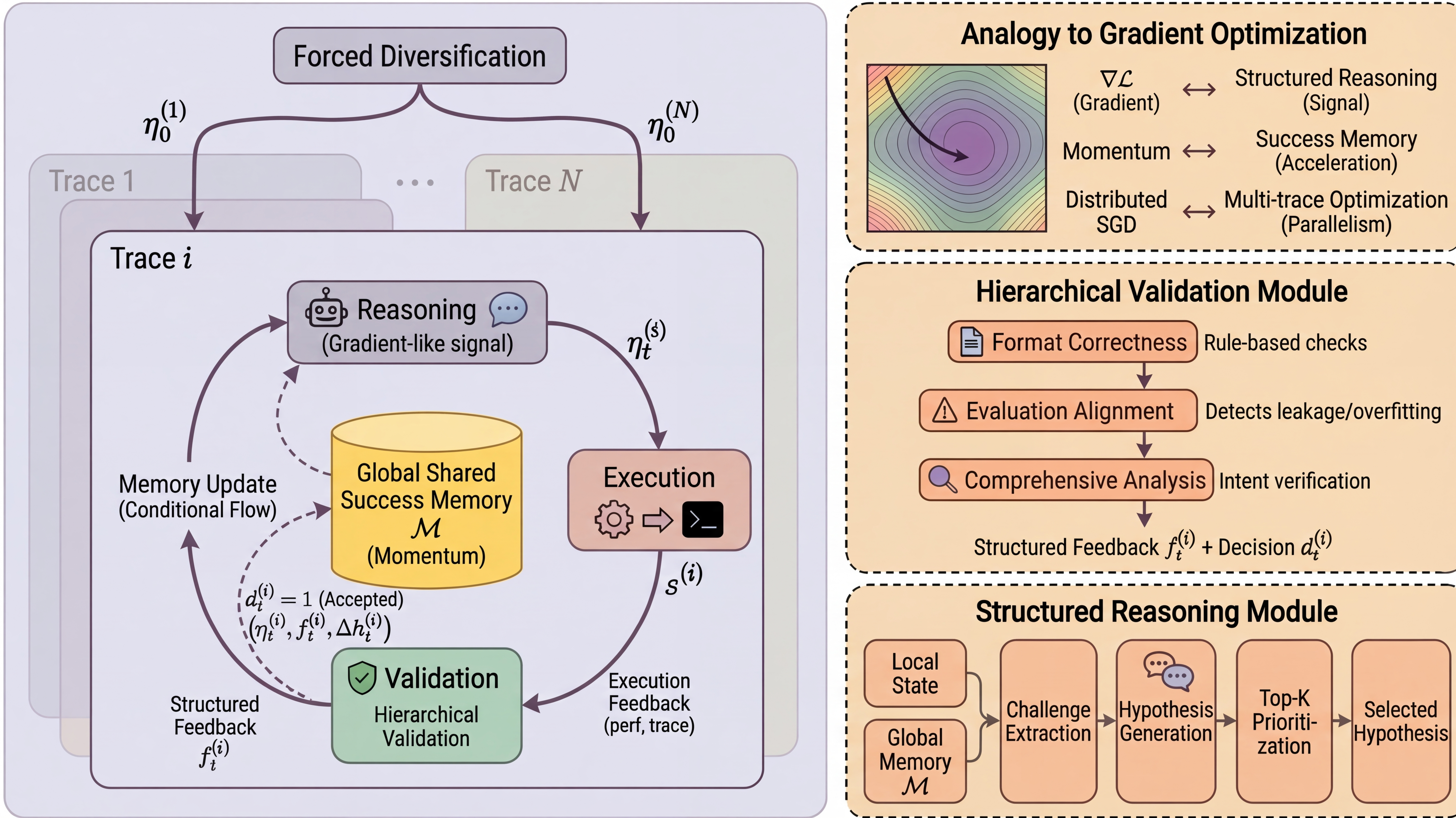
Its ablations reduce medal rate when structured reasoning or success memory is removed. This supports the components in that system. It does not make diagnosis the opposite of search: Gome still ranks hypotheses, and tree-based agents can also reason about execution feedback.
Deciding When Broader Search Is Worthwhile
Common infrastructure helps distinguish strategy from implementation quality. In Figure 7, different strategies feed into the same editing and execution loop. FML-bench gives agents the same editor, execution environment, metric display, and validation/test separation. Strategies still differ in prompts, memory, and actions, not just topology (Zou et al. 2026).

The study compares test-performance gains over the untouched baseline, divided by each metric’s best-to-worst reference range. Negative gains are clipped to zero. For three metrics without a natural worst bound, the baseline supplies that bound. This normalized improvement is neither raw accuracy nor relative percentage improvement.
Across 18 tasks with GPT-5.4, each agent–task pair received three independent runs of 100 validation executions. Greedy Autoresearch and tree-based TAS v2 achieved nearly identical mean improvements, 0.192 and 0.193. Their task-level strengths differed. AdaptiveSearch, which begins greedily and branches after stagnation, reached 0.208. This variant also adds geometry-based proposal guidance, partly calibrated using per-task results from the main experiments, so the gain does not isolate the switching rule alone. The result motivates adapting exploration to observed progress, but the criteria for doing so on unseen tasks need separate validation. Equal validation counts also do not equalize token or runtime costs.
Broader search also requires substantive alternatives. The scatter in Figure 8 associates higher architecture diversity with higher medal rate across agent configurations. The study measures that diversity through entropy over proposed model architectures. Entropy is higher when proposals are spread evenly across several architectures rather than concentrated on one. Prompting AIRA agents toward similar ideas reduced medal rate by 6.9 points for greedy search and 8.4 points for MCTS. Repeatedly attempting an expensive model that timed out explained a substantial part of the loss (Audran-Reiss et al. 2025).
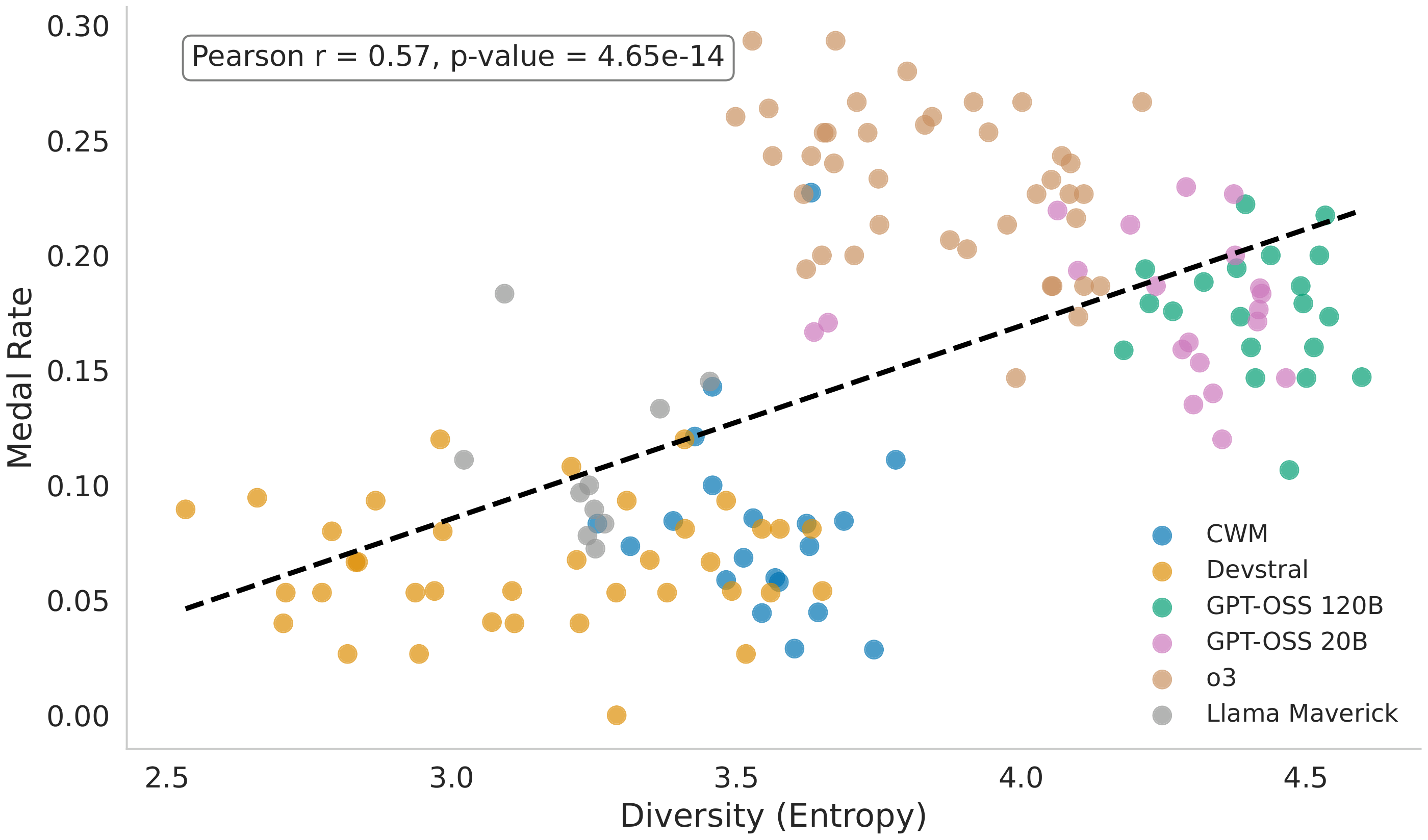
Diversity can therefore hedge against implementation failure. It is not itself scientific novelty. Understanding Results separates useful changes from ideas that merely differ from earlier ones.
Allocating Execution to Promising Proposals
Not every proposed idea needs an immediate training run. AIBuildAI-2.5 separates implemented candidate programs awaiting full training from candidates with measured performance. A judge assesses expected gain, grounding in existing results, and feasibility. In Figure 9, the Judge and Selector sit before the training runs: the Selector chooses execution order, and dashed proposed nodes remain distinct from filled executed nodes. Scheduling and model routing manage compute and inference costs (Qin et al. 2026).
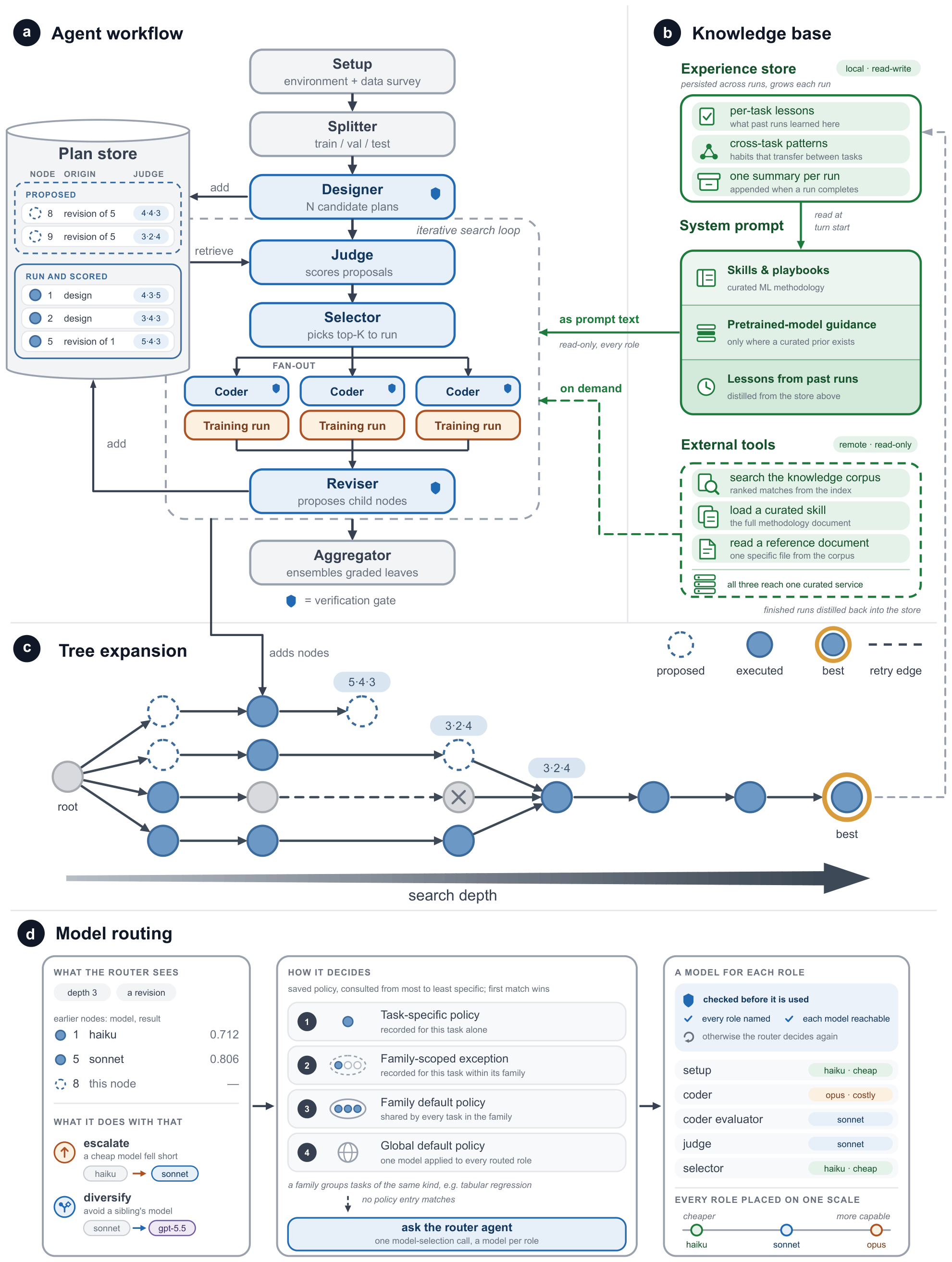
This extends the same principle from parent selection to execution allocation. Search is useful when it turns limited resources into informative, feasible changes. Its structure, the information supplied to its operators, and the code they can reliably produce must be considered together. Reusing Experience examines that information supply in more detail.
Figure Sources and Usage Terms
- Source: (Toledo et al. 2025) Figure 3 (original figure reproduced, converted to PNG, and whitespace trimmed. Original paper license: CC BY-NC-SA 4.0).
- Source: (Nam et al. 2025) Figure 2 (CC BY 4.0, original figure converted to PNG).
- Source: (Nam et al. 2025) Figure 24 (CC BY 4.0, original figure converted to PNG).
- Source: (Nam et al. 2025) Figure 3 (CC BY 4.0, original figure converted to PNG).
- Source: (Liu et al. 2025) Figure 5 (original figure reproduced, converted to PNG, and whitespace trimmed).
- Source: (Zhang et al. 2026) Figure 2 (original figure reproduced, converted to PNG, and whitespace trimmed. Original paper license: CC BY-NC-SA 4.0).
- Source: (Zou et al. 2026) Figure 2 (the original figure PDF, identical to that in the official repository, converted to PNG and whitespace trimmed. Figure distribution license: Apache 2.0).
- Source: (Audran-Reiss et al. 2025) Figure 1 (original figure reproduced, converted to PNG, and whitespace trimmed. Original paper license: CC BY-NC-SA 4.0).
- Source: (Qin et al. 2026) Figure 1 (the complete original figure reproduced, with format conversion to PNG only. Original paper license: CC BY-NC-ND 4.0).