Reusing Experience
What should a new experiment inherit from earlier work? For the tabular classifier, the answer might be working preprocessing code, a comparison of encoding methods, or a warning that an expensive model repeatedly timed out. These objects support different decisions. Useful reuse preserves enough information for the receiver to decide what applies and what still needs testing.
This chapter follows three steps: obtaining relevant experience, turning it into something actionable, and checking it under the receiver’s conditions. Passing a conversation or a report is only one way to connect those steps.
Finding Relevant Prior Work
Experience can come from outside the current search or from its own trials. CoMind uses both: Figure 1 connects shared kernels, datasets, and discussions to a coordinator, which receives results from the coding and evaluation loop. It analyzes public Kaggle notebooks and discussions, extracts feasible ideas, sends plans to coding agents, and returns code and evaluation reports to its internal community (S. Li et al. 2026).
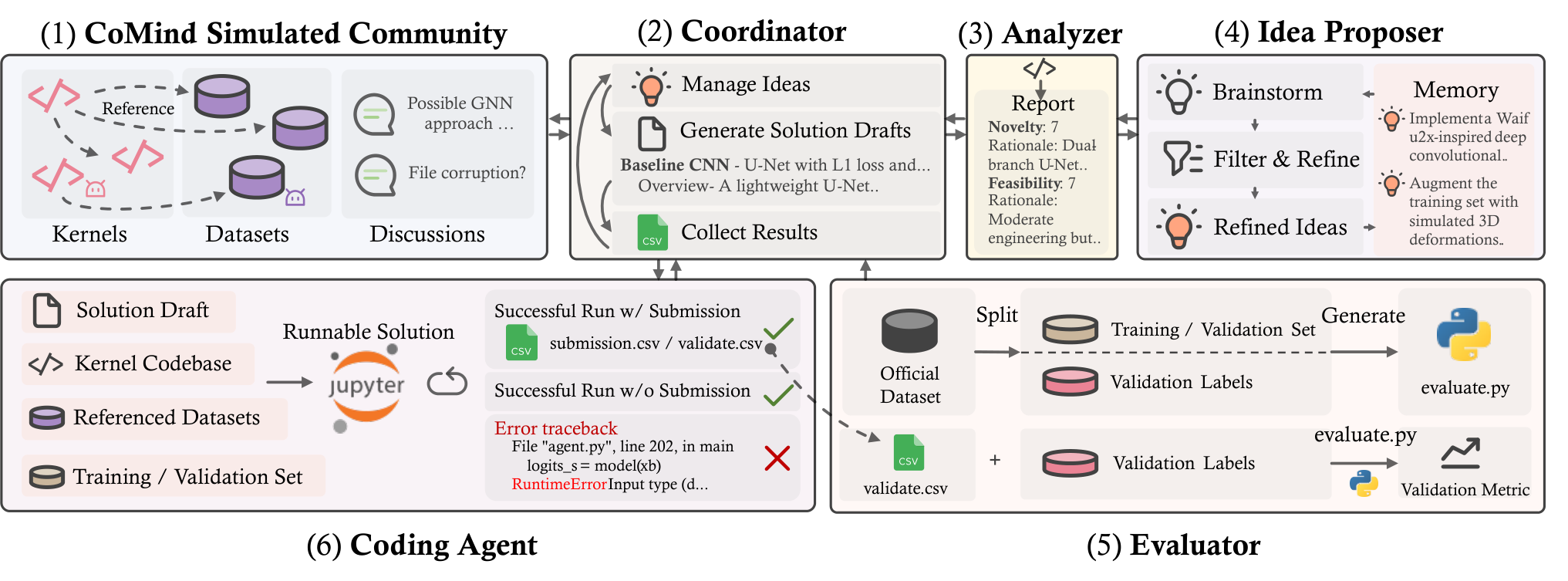
In a resource-restricted comparison on 20 MLE-bench Lite competitions, all methods used o4-mini, four vCPUs, and a five-hour budget. CoMind achieved a mean win rate of 0.668, against 0.510 for AIDE with retrieval and summarization. Win rate measures the fraction of human competitors outperformed. Removing public materials also reduced CoMind’s performance. The results support using external experience through analysis and implementation, although the difference from AIDE includes changes to the workflow, not only report sharing. Public contributions also embody work already done by humans.
AgentRxiv offers a different interface: the laboratories in Figure 2 connect through a shared archive, uploading reports and retrieving previous reports while developing new experiments (Schmidgall and Moor 2025).
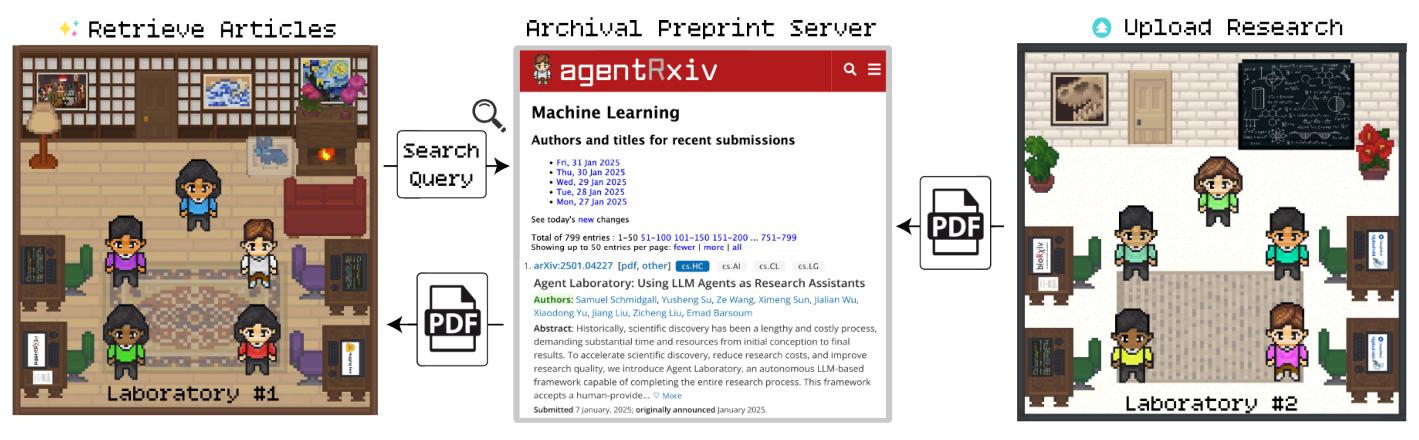
Shared reports supported iterative improvement in the paper’s reasoning experiments. Parallel laboratories progressed faster in elapsed time but also duplicated work and consumed more resources. The authors manually checked the code and outputs behind reported accuracies after encountering fabricated results and faulty code repair. A searchable archive makes experience available. It does not make every claim in it trustworthy.
Making Experience Actionable
Long logs are valuable for investigation but cumbersome for every proposal. A short lesson can identify a change, its observed outcome, and the conditions that matter.
MARS constructs improvement lessons by comparing the current repository with the best-known solution and combining the code difference with execution results. Separate debugging lessons record failed code, errors, and effective fixes. The shared lesson pool in Figure 3 returns these records to later modifications across branches of the same task (Chen et al. 2026).
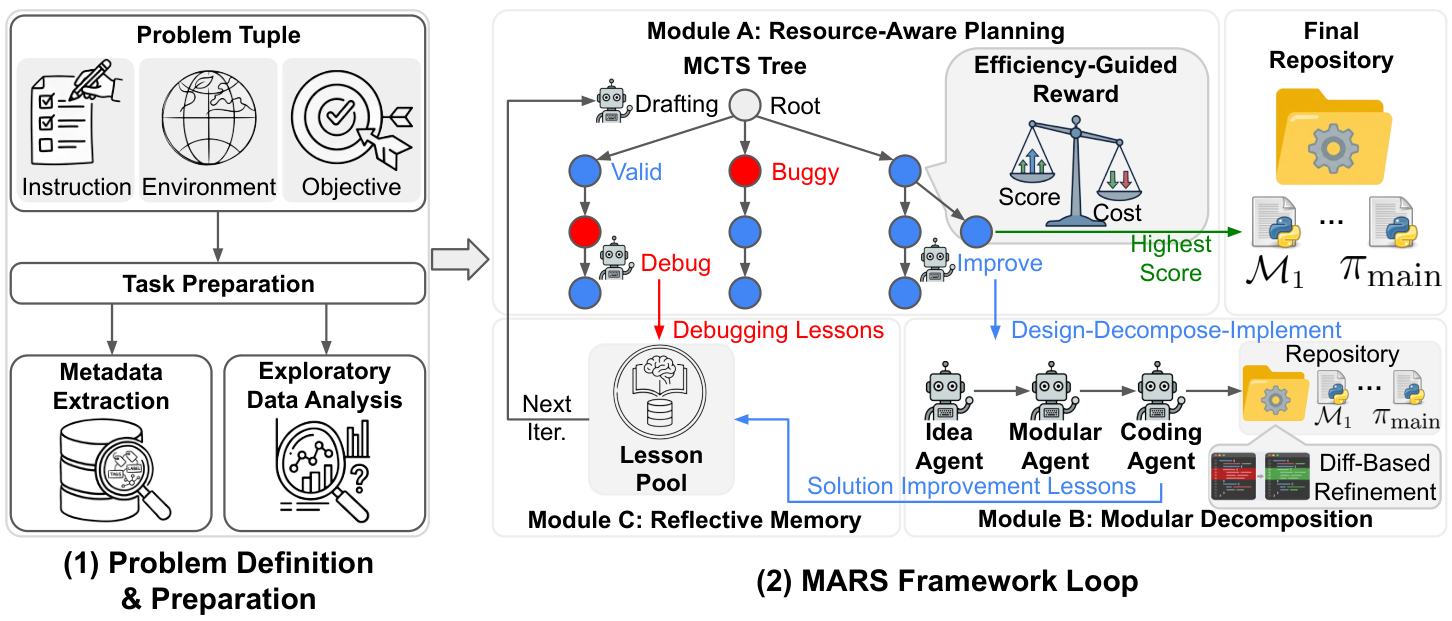
MARS reports that 63.0±1.8% of used improvement lessons originated in another branch. This measures where consulted lessons came from, not the fraction of new tasks successfully solved. Removing memory or comparative distillation reduced performance in its ablations. Code comparisons make explanations more specific, but several simultaneous changes or random training variation can still leave their cause uncertain. A lesson is actionable evidence and a hypothesis, not automatically a controlled causal finding.
Links to original candidates can complement short lessons. MLEvolve separates generative ancestry, which records the parent code, from reference relationships, which record other trials consulted during a modification (Du et al. 2026).
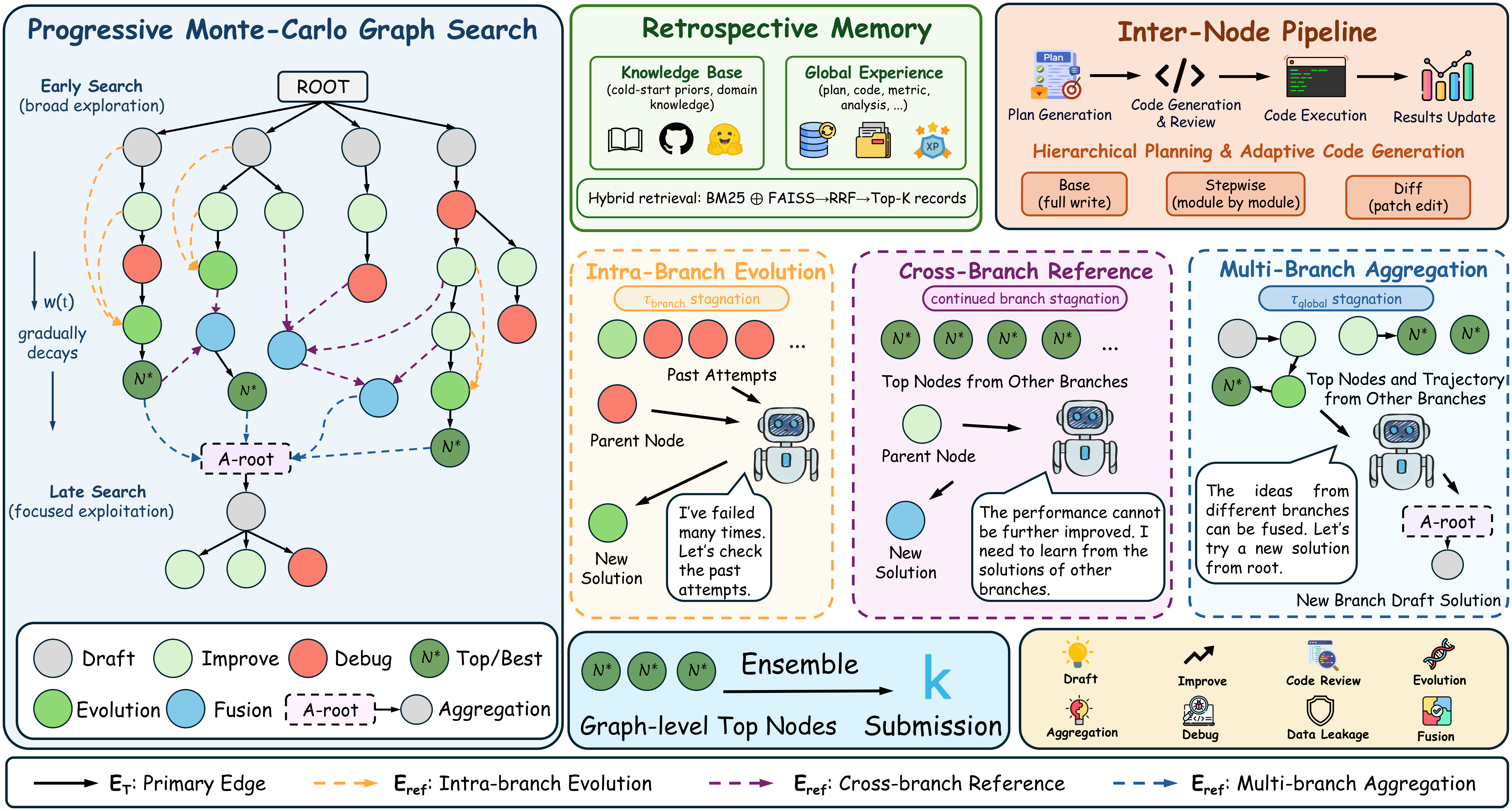
The different links in Figure 4 matter: if candidate B modifies A using an observation from C, A remains B’s parent and C becomes a reference. Search statistics propagate through ancestry, not reference links. In a nine-task ablation, removing same-branch retrospective operations reduced medal rate from 66.67% to 33.33%, while removing cross-branch operations reduced it to 55.56%. The comparison removes the operations that use these histories, so it supports their role in this system rather than an isolated effect of reading a reference. Both local experience and cross-branch reuse matter.
Beyond reference links, MLEvolve maintains a domain knowledge base for initial proposals and records of plans, outcomes, analysis, and feedback accumulated during search. Planning retrieves successful and failed experience, while debugging retrieves similar resolved errors. References to candidates and retrieval of decision-relevant information work together.
Checking a Change Where It Will Be Used
Copying a successful design carries an assumption: the receiver has conditions in which it helps. Population Evolution makes that assumption testable. Local searches publish executable interventions, mechanism descriptions, provenance, and scores. Other searches apply the intervention to their own baselines and retrain using their own data, initialization, and training allocation (Peng et al. 2026).
This is design transfer, not copying trained weights. Peer results enter a shared ledger and inform subsequent proposals, while each search retains its own population. Candidates meeting peer-screening criteria can proceed to larger-scale evaluations.
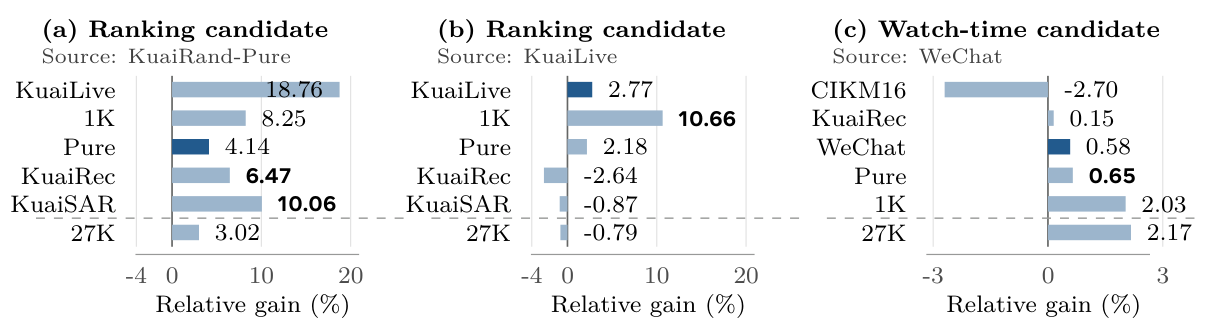
The bars in Figure 5 make the benefit of replay concrete. Panel (a) improves all peers and retains a gain below the dashed scale boundary. Panel (b) improves several small-scale conditions but regresses at larger scale. Panel (c) mixes gains and losses even among small-scale receivers. Receiver measurements tell the search more than a sender’s success alone.
The paper studies both iteration-matched source searches and a separate comparison with total GPU compute matched. Those are different efficiency questions. In its hierarchical setting, full-target outcomes are withheld from subsequent proposals, even though they are used to report final results. This preserves the distinction between evidence available during discovery and later evaluation.
Recording Failures Without Banning Too Much
A failed experiment can narrow the next search if its record explains what failed under which conditions. “Do not use this model” is usually less helpful than “this training path repeatedly exceeded the available CPU budget.”
Negative Knowledge creates compact records of failure type, scope, risky operations, and alternatives. The accept/reject step in Figure 6 requires a later agent to decide whether each record applies, with a reason (Wang 2026).
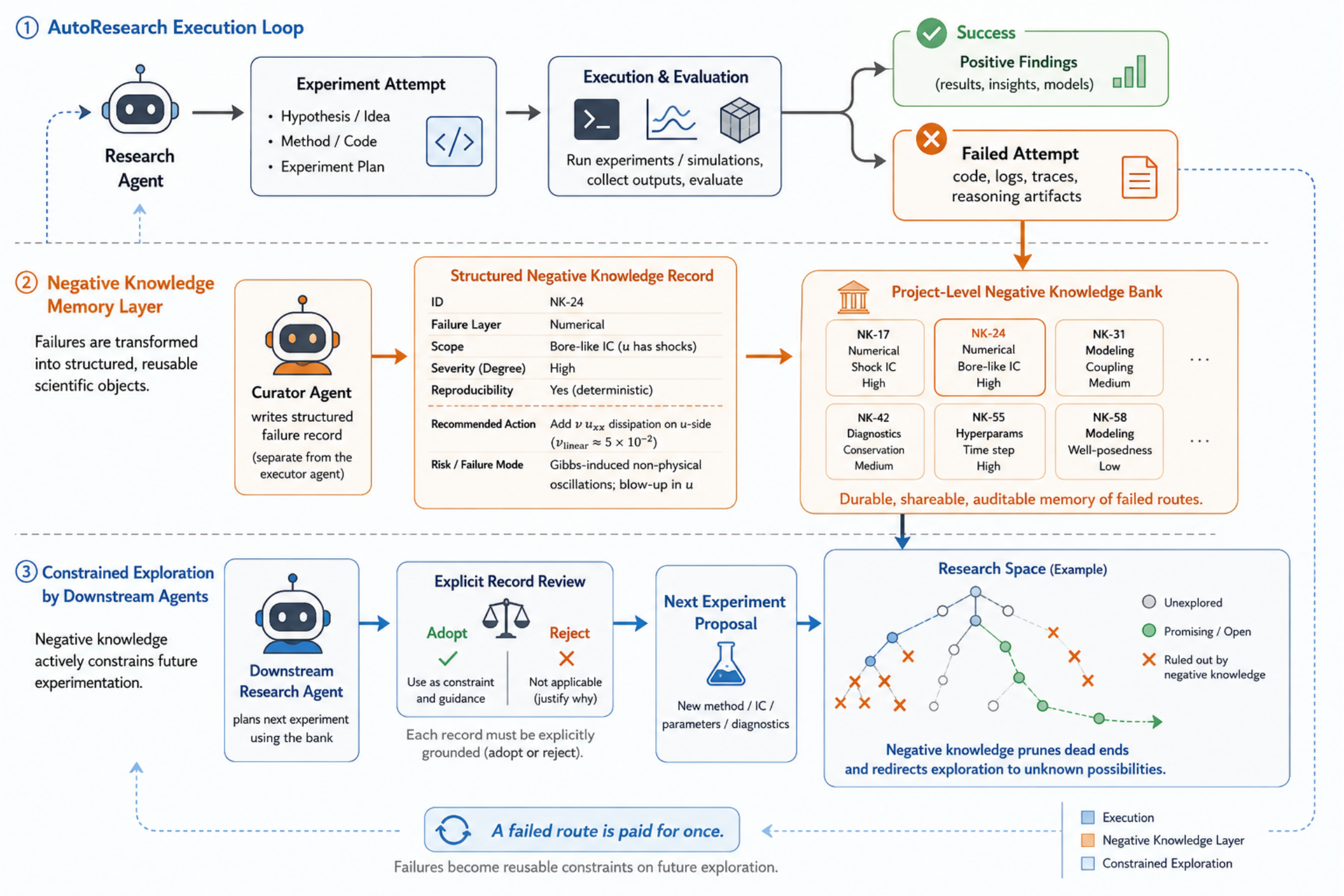
In its electroencephalography example, repeated training attempts consumed the CPU budget. Reusing that failure pattern prompted a shift toward closed-form least squares rather than another small adjustment to training. Conversely, a numerical method transferred from a related equation became unstable under a different sign convention. Failure knowledge should rule out supported failure paths without treating untested alternatives as disproved.
Continuing Work Without Keeping Every Conversation
The most direct reuse is to continue from an existing workspace. Humanize MLE Agents (HMA) alternates native agents and resets their conversations. The task-state box shared by Options A and B in Figure 7 preserves the workspace and evaluated candidates. Code and caches survive the switch (C. Li et al. 2026).
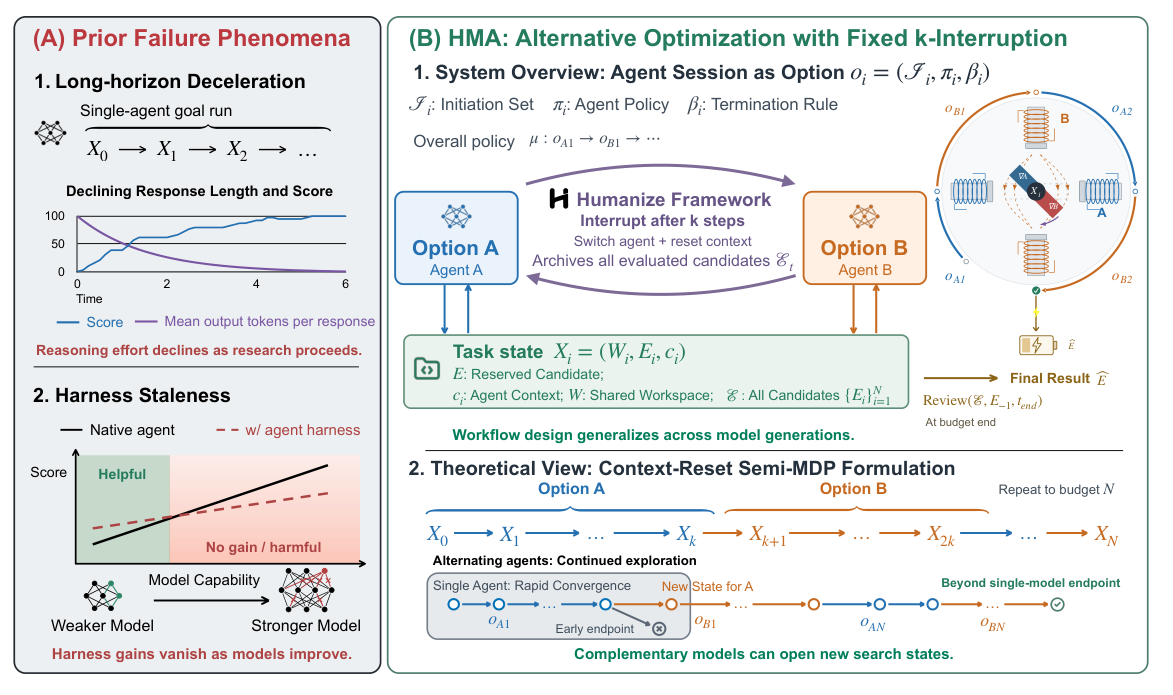
This separates three choices: who acts next, what conversational history they receive, and which work products survive. Changing all three at once would make a handoff difficult to interpret.
The Handoff Tax studies the conversation interface directly on SWE-bench Verified, a software repair benchmark. All four columns in Figure 8 retain the edited working tree. What changes is the conversation: full history, a summary written by either the predecessor or successor, or no conversation (Ganz et al. 2026).
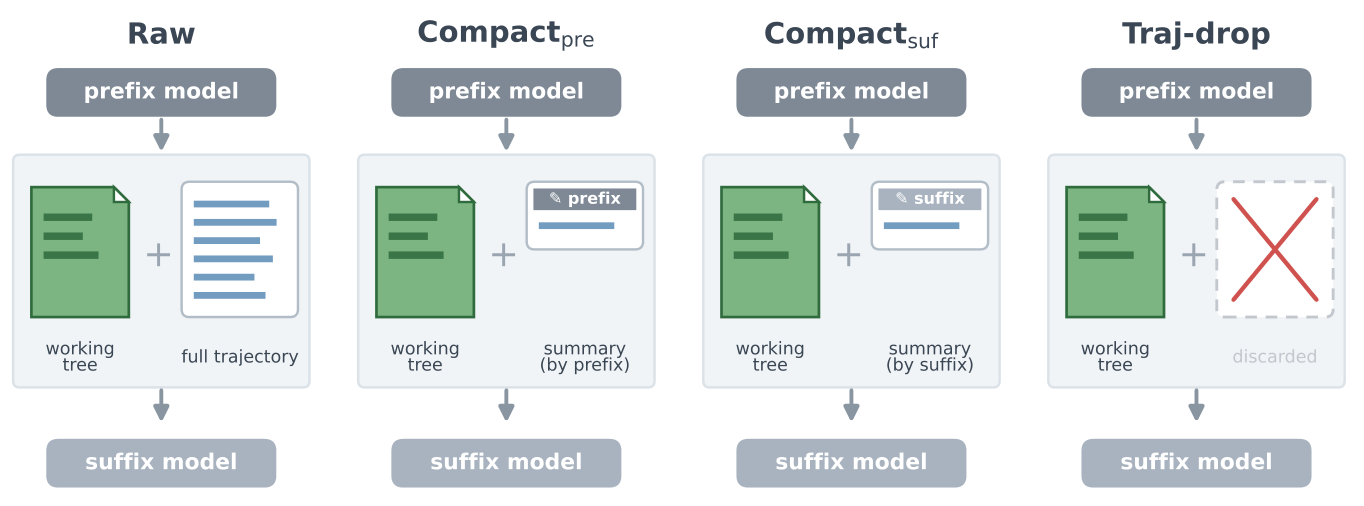
For the tested model pairs, dropping a weaker predecessor’s trajectory helped a stronger successor, while preserving the stronger predecessor’s history helped the reverse handoff. This is evidence from software repair, not a direct test of HMA. It nevertheless clarifies why more inherited context need not mean more usable knowledge.
Across these designs, the essential chain is the same: retrieve relevant work, preserve its conditions and provenance, and obtain new evidence when applying it elsewhere. Understanding Results asks how that evidence should revise the explanations guiding the next experiment.
Figure Sources and Usage Terms
- Source: (S. Li et al. 2026) Figure 2 (CC BY 4.0, original figure converted to PNG).
- Source: (Chen et al. 2026) Figure 2 (CC BY 4.0, converted to PNG and whitespace removed).
- Source: (Du et al. 2026) Figure 2 (original figure reproduced, converted to PNG and whitespace removed).
- Source: (Peng et al. 2026) Figure 2 (original figure region reproduced, converted to PNG).
- Source: (Wang 2026) Figure 1 (CC BY 4.0, original figure converted to PNG).
- Source: (Schmidgall and Moor 2025) Figure 3 (CC BY 4.0, original figure region cropped and converted to PNG).
- Source: (C. Li et al. 2026) Figure 1 (CC BY 4.0, original figure region cropped and converted to PNG).
- Source: (Ganz et al. 2026) Figure 2 (original figure region reproduced, converted to PNG).