Multi-Image Understanding
Multi-Image Understanding is the ability to simultaneously process multiple images and understand their relationships and differences. Unlike traditional single-image processing, which treats each image independently, Multi-Image Understanding captures relationships between multiple images.
Differences from Single-Image Processing
Single-Image Processing:
- Performs question answering or caption generation for a single image
- Cannot compare or understand relationships between images
- Difficult to handle multi-page documents or before-and-after comparisons
Multi-Image Understanding:
- Processes sets of 2-5 semantically related images
- Understands commonalities and differences between images
- Enables cross-image question answering and grounding
Molmo2-MultiImageQA Dataset
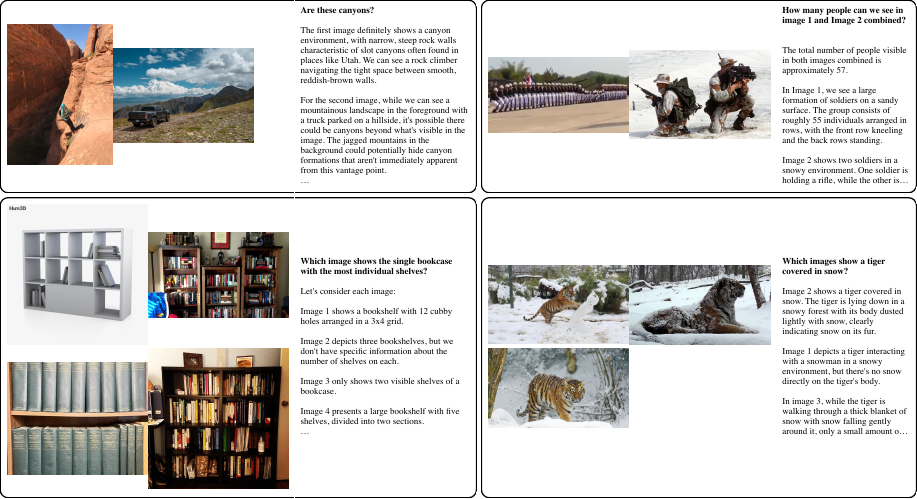
Molmo2-MultiImageQA is a question-answering dataset for semantically related image sets.
Dataset Scale:
- 45,000 image sets (composed of 96,000 unique images)
- 72,000 question-answer (QA) pairs
- 2-5 images per set (average 2.73)
Collection Method: The dataset was constructed through human annotation using the following process:
- Generate captions for each image using a model trained on PixMoCap
- Group images based on sentence-level similarity of captions
- Annotators create questions for each set
- Improve answers through an iterative loop with Claude Sonnet 4.5
This approach produced a high-quality dataset that supports real-world multi-image queries.
Molmo2-MultiImagePoint Dataset
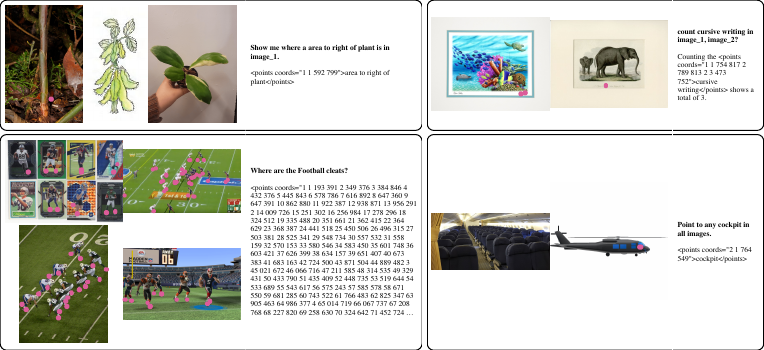
Molmo2-MultiImagePoint is a pointing and counting dataset spanning multiple images.
Dataset Scale:
- Over 470,000 pointing and counting examples
- 2-5 images per set (average 3.24)
Collection Method: The dataset was synthetically constructed using the following pipeline.
Data Collection Pipeline
| Step | Description |
|---|---|
| Step 1: Soft Clustering of Images | Use images from PixMo-Points; combine single-token and sentence-level embeddings to generate semantically related sets of 2-5 images |
| Step 2: Label Normalization | Lowercase the text, normalize punctuation and whitespace, and consolidate synonyms |
| Step 3: Canonical Label Generation | Use an LLM to merge the normalized labels into a single canonical description that captures the entity/concept shared across all images |
| Step 4: Training-time Sampling | Sample from the original annotations (not just the canonical label) to preserve lexical diversity and improve robustness |
A canonical label is a standardized description that unifies multiple human annotations within an image set. For example, different expressions such as “waterfall,” “cascade,” and “falls” are unified into a single canonical label: “waterfall.”
However, rather than always using canonical labels during training, the model probabilistically samples from the original annotations as well, building a model that can handle diverse expressions.
Molmo2-SynMultiImageQA Dataset
Molmo2-SynMultiImageQA is a synthetic multi-image dataset specialized for text-rich images.
Dataset Scale:
- 188,000 synthetic multi-image QA examples
Collection Method: The dataset was built by extending CoSyn [172]. CoSyn is a framework that synthetically generates question-answering pairs for text-rich images such as charts, tables, and documents.
Target Image Types:
- Charts
- Tables
- Documents
These text-rich images are critical data directly relevant to practical tasks such as document understanding and cross-document comparison.
Document Understanding:
- Comparing clauses across multiple pages of a contract
- Consistency checking between different sections of a report
- Content comparison across multiple invoices
Multi-Image Comparison:
- Comparing product photos from different angles to understand features
- Change detection in before-and-after photos
- Trend analysis across multiple charts and graphs
Grounding:
- Cross-image pointing such as “Point to the waterfall in all images”
- Counting such as “How many images contain a red car?”
- Detecting common objects across the entire set
Dataset Statistics
| Dataset | Scale | Image Set Size | Collection Method | Purpose |
|---|---|---|---|---|
| Molmo2-MultiImageQA | 45k sets 72k QA |
2-5 images (avg. 2.73) |
Human | General QA |
| Molmo2-MultiImagePoint | 470k examples | 2-5 images (avg. 3.24) |
Synthetic | Pointing & Counting |
| Molmo2-SynMultiImageQA | 188k examples | - | Synthetic (CoSyn extension) |
Text-rich image QA |
Importance of Multi-Image Understanding
Multi-Image Understanding enables the following tasks that were impossible with single-image processing.
Information Integration: It integrates information from multiple sources (images) to provide comprehensive understanding.
Comparison and Contrast: It can clearly identify commonalities and differences between images.
Document Processing: It enables understanding across multi-page documents or multiple related documents.
Real-World Application: In real-world applications, scenarios involving multiple images arise frequently (e.g., product images on e-commerce sites, time-series comparison of medical images, multiple surveillance camera angles, etc.).
Molmo2 achieves state-of-the-art Multi-Image Understanding among open-source models by leveraging these three datasets.